Heroin in America: Why Use Is Falling, Where the Damage Is Worst, and How People Get Help
By Rachel Simmons, Health & Wellness Writer
Heroin was once the face of the American drug crisis, and for a long stretch of the 2000s and 2010s it was the drug that filled emergency rooms, newspaper headlines, and city morgues from Appalachia to the Northeast. Today the story looks very different. Heroin use and heroin deaths have fallen sharply, yet the drug has not disappeared. It has been displaced, and very often contaminated, by fentanyl, a synthetic opioid that is far more potent and far more unpredictable. This article explains what heroin is, how it is made and used, what the buzz feels like and why it is so hard to walk away from, what the drug does to brain chemistry, the surprising medical story behind it, why use has declined, where it is most prevalent and which American cities have struggled the most, and where to turn for help. It is written for education and prevention, and it is not a substitute for medical advice.
What Is Heroin and How Is It Made?
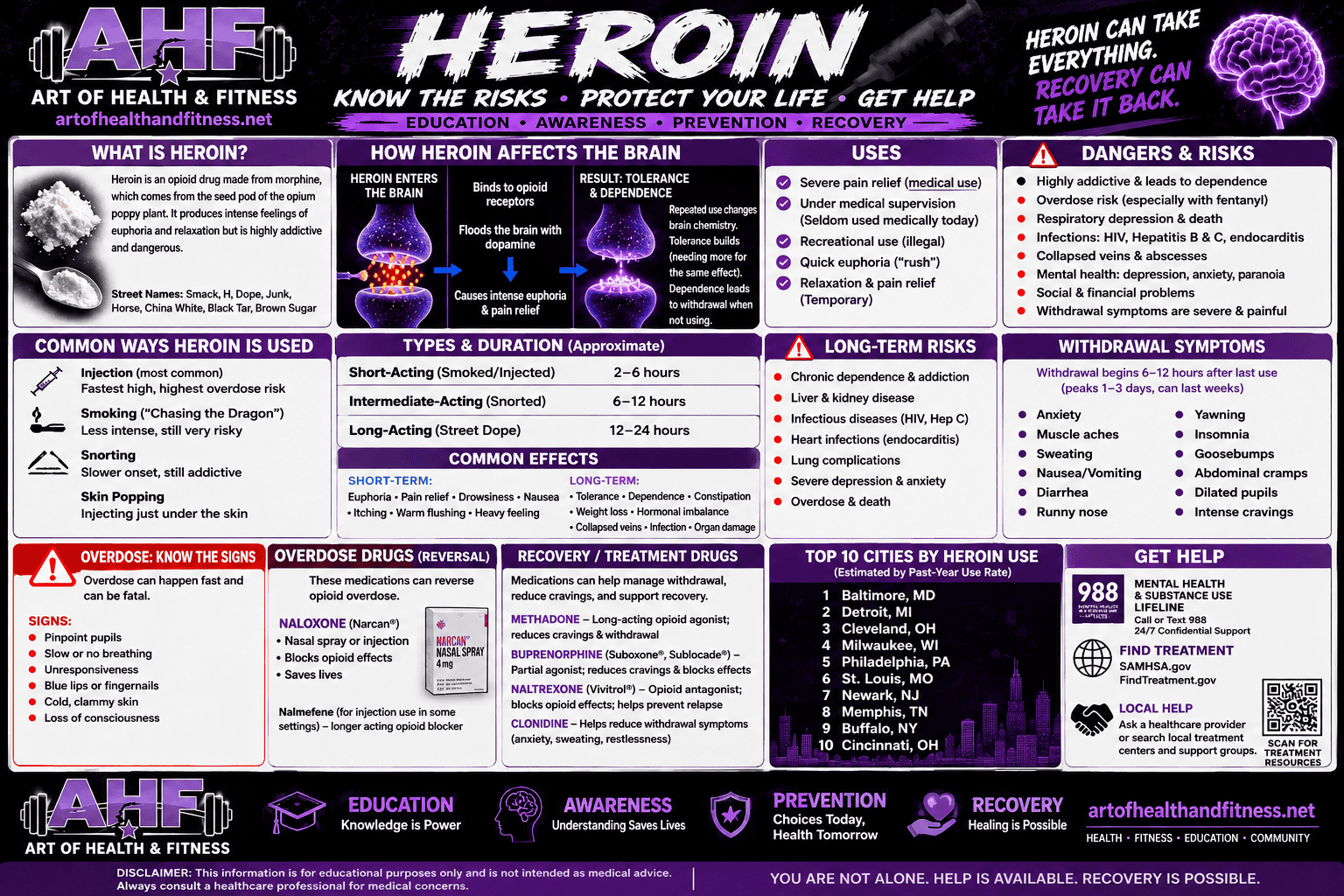
Heroin is a semi-synthetic opioid whose chemical name is diacetylmorphine. It starts as a plant. The opium poppy produces a milky latex in its seed pods, and that latex contains morphine, a natural painkiller that doctors have relied on for centuries. Heroin is made by chemically modifying morphine, a change that lets the drug enter the brain much faster than morphine does, which is why it hits harder and why it became so attractive on the illegal market. The specifics of that process are deliberately left out of this article, because the chemistry is dangerous and illegal, and it is not what matters for public health. What matters is where the raw material comes from and what ends up on the street. Illicit heroin is produced in clandestine labs, usually close to where the poppies are grown, and it shows up in several forms: a white or off-white powder, a brown powder, and a sticky dark substance known as black tar. Because there is no quality control of any kind, the strength and the contents change from batch to batch, and street heroin is routinely cut with other substances, increasingly including fentanyl.
The supply chain has always had a clear geography. For decades Afghanistan was the world’s largest source of opium, with Southeast Asia and Latin America supplying much of the rest, and the heroin sold in the United States in recent years has come mostly from Mexico. The United Nations Office on Drugs and Crime reports that after the Taliban banned poppy cultivation in 2022, Afghan opium production collapsed by well over 90 percent, which moved Myanmar into the position of the world’s largest opium producer. Those global shifts matter at home, because they are one reason heroin has become harder to find, and one reason the illegal opioid market has leaned so heavily on synthetic drugs that require no farmland at all.
How Heroin Is Used
Heroin is most often injected, smoked, or snorted, and some people swallow it. The route matters because speed matters. Injecting delivers the drug to the brain within seconds, which produces the strongest rush and carries the highest risk of addiction and overdose, along with the infection risks that come with injection, including abscesses, collapsed veins, bloodstream and heart valve infections, and the spread of HIV and hepatitis C. Smoking and snorting are slightly slower, but they are not safe alternatives. They still produce physical dependence, they still carry a serious risk of overdose, and many people who start by smoking or snorting move on to injecting as tolerance builds and the drug stops delivering the same relief.
For many Americans the path to heroin did not begin with heroin. Public health researchers have documented for years that a large share of people who developed heroin dependence in the 2000s and 2010s had first misused prescription opioid painkillers, and then turned to heroin when pills became harder or more expensive to get. That pill-to-heroin pipeline helps explain why the crisis reached so many suburbs, small towns, and communities that never saw themselves as part of the drug world.
What the Heroin Buzz Actually Feels Like
The first thing people describe is the rush, a wave of warmth and pleasure that spreads through the body within seconds to minutes depending on how the drug is taken. Pain fades, anxiety melts away, and many people describe a feeling of being wrapped in a heavy, comforting blanket. After the rush comes a long stretch of calm and drowsiness, often called nodding, in which a person drifts in and out of wakefulness. Physically, the heartbeat and breathing slow down, the mouth gets dry, the limbs feel heavy, the skin flushes and itches, and the pupils shrink to pinpoints. Nausea and vomiting are common, especially for first-time users. The high typically lasts a few hours and then gives way to a crash that delivers the opposite of everything the drug provided: aches, restlessness, irritability, and a growing craving.
That contrast is the heart of the trap. The pleasure shrinks with repeated use as tolerance builds, so people need more of the drug to feel the same effect, while the misery of going without it grows worse. Over time many people are no longer chasing a high at all. They are using to avoid feeling sick. The very effect that makes the drug feel so soothing, the slowing of the breath, is also what kills, because a dose that is too large for the body can slow breathing until it stops.
Heroin and Brain Chemistry: Endorphins, Dopamine, and the Brainstem
Once heroin enters the bloodstream it crosses the blood-brain barrier quickly and is converted into morphine, which attaches to mu-opioid receptors found throughout the brain, the brainstem, and the spinal cord. These are the same receptors that the body’s natural endorphins use to dampen pain and produce feelings of wellbeing, but heroin activates them far more powerfully and for far longer than anything the body makes on its own. Three effects matter most.
The first is reward. In a region of the midbrain called the ventral tegmental area, heroin switches off GABA neurons that normally act as brakes on dopamine cells. With the brakes released, dopamine surges into the nucleus accumbens, the brain’s reward center, and the brain learns that this experience is worth repeating. That learning is the root of craving. This is a different route than the one cocaine takes, since cocaine blocks the cleanup of dopamine while opioids release the brakes that hold it back, but both roads lead to the same reward circuit and the same cycle of seeking and relapse.
The second effect happens in the brainstem, where opioid receptors help control breathing. Heroin lowers the brain’s sensitivity to rising carbon dioxide, which is the signal that normally tells you to take another breath, and that is why overdose deaths come from slow, shallow, or stopped breathing, often with blue or gray lips, unresponsiveness, and pinpoint pupils.
The third is adaptation. The brain compensates for the constant flood of opioid by dialing down its own endorphin system and ramping up the stress chemistry that heroin suppresses, including norepinephrine produced in a region called the locus coeruleus. When the drug wears off, that stress system rebounds, which produces the sweating, shaking, cramps, diarrhea, anxiety, and misery of withdrawal. Over months and years, repeated use also weakens the prefrontal circuits involved in judgment and impulse control, which helps explain why people who sincerely want to stop find it so hard.
The Medical Side of Heroin
The surprising thing about heroin is that it began as a medicine, and in some parts of the world it still is one. Diacetylmorphine was first synthesized in 1874, and the German company Bayer began marketing it in 1898 as a cough suppressant and a supposedly safer alternative to morphine, a claim that fell apart as addiction spread. The United States restricted the drug with the Harrison Narcotics Act of 1914 and later banned it outright, and today it is a Schedule I substance with no accepted medical use under federal law. Other countries see it differently. In the United Kingdom, diacetylmorphine goes by the name diamorphine and is prescribed in hospitals for severe pain after surgery, for pain during a heart attack, and for comfort in end-of-life care, because it is potent and dissolves into a very small injection volume. Switzerland, Germany, the Netherlands, Denmark, and Canada have also run heroin-assisted treatment programs for the small group of people with long-standing opioid dependence who have not improved on methadone or buprenorphine. In those programs the patient receives pharmaceutical-grade medication under clinical supervision, and studies have linked the approach to less street drug use, fewer infections, lower crime, and better overall health for people who had been out of reach of every other treatment.
It is important to be clear about what this does and does not mean. Those benefits belong to a regulated medication given by trained staff, with a known dose and a medical plan, and they say nothing positive about street heroin, which has unknown strength, unknown contents, and no safety net. In the United States, doctors rely on other opioids for severe pain, and the treatments with the strongest evidence for opioid addiction are the medications methadone, buprenorphine, and naltrexone. Even so, federal survey data show that only about one in six Americans with opioid use disorder receives one of those medications.
Is Heroin Use Declining?
Yes, and the numbers are striking. CDC data show that heroin-involved overdose deaths peaked at roughly 15,000 a year around 2016 and 2017, and the age-adjusted heroin death rate fell by about a third between 2022 and 2023 alone, from 1.8 to 1.2 deaths per 100,000 people. The National Survey on Drug Use and Health estimated that about 556,000 Americans aged 12 and older used heroin in 2024. Overall overdose deaths tell the same story on a larger scale. They peaked near 110,000 in 2022, fell by more than a quarter in 2024, and provisional CDC counts for 2025 point to roughly 70,000, around a third below the peak and close to pre-pandemic levels.
Several forces explain the shift. The biggest is fentanyl, which has displaced heroin across much of the country because it is cheaper and easier for traffickers to make, move, and hide. In many cities a person who believes they are buying heroin is actually getting fentanyl or a mixture of the two. Afghanistan’s poppy ban shrank the raw supply, and the United Nations has reported that the stockpiles cushioning the market were expected to run low by the end of 2026. At the same time, naloxone became available without a prescription, treatment access expanded, billions of dollars from opioid lawsuit settlements began flowing to prevention and recovery programs, and harm reduction services saved large numbers of lives. Fewer new people are also starting, and a generation of long-term users has aged or died.
The decline is real, but it is not the same as safety. Heroin’s replacement is in many ways a more dangerous supply, and UNODC has warned that a tighter heroin market may push even more users toward synthetic opioids. Some Western states, including New Mexico and Arizona, reported increases in overdose deaths in 2025 even as the national total fell, a reminder that national averages can hide local surges.
Where Heroin Is Most Prevalent in the United States
Heroin has never been spread evenly across the map. East of the Mississippi River the market has been dominated by powdered heroin, while west of it Mexican black tar heroin has long been the norm. Use has been heaviest in the Northeast, the Mid-Atlantic, Appalachia, and the industrial Midwest, in states such as Pennsylvania, Ohio, West Virginia, Kentucky, Maryland, Massachusetts, and New Jersey, where the pill-to-heroin pipeline hit hardest and the drug was cheap and widely available. Parts of the Southwest, notably northern New Mexico, have also recorded some of the highest heroin death rates in the country for decades. Those patterns describe an older map, though. Today the line between a heroin problem and a fentanyl problem has nearly disappeared, so the places struggling with illicit opioids are the places living with heroin’s legacy.
Which American Cities Have Struggled the Most?
A handful of cities come up again and again, with the caveat that rankings change depending on whether they count deaths, treatment admissions, or emergency room visits, and whether they use city or county boundaries. Baltimore has long been called one of the country’s heroin capitals, and in recent CDC data it still has the highest overdose death rate among large American cities, with San Francisco now ranking second. Philadelphia’s Kensington neighborhood has been the center of that city’s opioid crisis for years and has recorded more overdose deaths than any other part of the city, although Pew’s 2025 polling suggests residents’ views on the crisis are shifting as deaths come down. Huntington, West Virginia, became a national symbol in 2016 when more than two dozen people overdosed within a few hours, and it has since become a case study in recovery, with coordinated treatment and fewer deaths. Ohio cities such as Dayton and Cincinnati have also been among the hardest hit, and closer to home, New Jersey cities including Newark and Camden have long contended with heroin and now with fentanyl-laced supply.
What these places share is more important than where they sit on a list. Most are older industrial or port cities with concentrated poverty, a history of job loss, open-air drug markets, and neighborhoods where treatment and housing have not kept pace with need. They also show that places can turn the corner. Cities that invested in naloxone distribution, medications for opioid addiction, and outreach to the people most at risk have seen deaths fall faster than the national average.
Withdrawal, Treatment, and Recovery
Opioid withdrawal is rarely life-threatening by itself, but it is brutal. Symptoms usually begin within about 6 to 12 hours of the last dose, peak over the first few days, and fade over roughly a week, although cravings, poor sleep, and low mood can linger for weeks or months. The sharpest danger comes afterward. Tolerance drops quickly during abstinence, so a person who relapses and returns to their old amount can overdose on a dose their body no longer knows how to handle. That is why quitting cold turkey alone is not recommended, and why medical supervision is safer.
The strongest evidence supports three medications. Methadone is dispensed through licensed opioid treatment programs and steadies the brain’s opioid receptors without the roller coaster of a high and a crash. Buprenorphine can be prescribed in a doctor’s office, activates the receptors gently, and has a built-in ceiling on its effects that lowers overdose risk. Naltrexone blocks the receptors entirely, but it requires a person to be fully off opioids first. These medications work best alongside counseling, peer support groups such as Narcotics Anonymous, and practical help with housing, work, and family. Treatment is not a failure when relapse happens. For a chronic condition like opioid use disorder, relapse is a signal to adjust the plan.
Where to Get Help Right Now
If you or someone you love is using heroin or other opioids, free and confidential help is available around the clock. The SAMHSA National Helpline at 1-800-662-4357 offers treatment referrals and information 24 hours a day, every day of the year, in English and Spanish. The website FindTreatment.gov lets you search for treatment programs, including opioid treatment programs, by location. Anyone in emotional crisis can call or text 988 at any time, and a suspected overdose is always a 911 emergency.
Because so many overdoses now involve fentanyl, it also helps to know how to respond. Naloxone, sold as Narcan, is available without a prescription at most pharmacies and can reverse an opioid overdose. The signs to watch for are slow or stopped breathing, blue or gray lips and fingertips, pinpoint pupils, and a person who cannot be woken up. Call 911 first, give naloxone if you have it, and stay with the person until help arrives, because the effects of naloxone can wear off before the opioid does. Carrying it can save a life, whether it is for a family member, a friend, or a stranger. For more on this subject, you can browse our addiction and recovery articles.
The Bottom Line
Heroin is a drug with a complicated history. It began as a medicine, it became one of the most destructive street drugs in American history, and it has now been largely overtaken by something even more dangerous. Use and deaths have fallen sharply from their peaks, and that is genuinely good news, but the decline is uneven, the supply is riskier than ever, and the cities and neighborhoods that carried the heaviest burden are still recovering. The brain chemistry explains why willpower alone is rarely enough, and the research explains why medications and support work better than going it alone. Recovery is possible, and it usually starts with a single call. This article is for general education and is not a substitute for medical advice.
Sources: CDC National Center for Health Statistics and provisional overdose death data, SAMHSA National Survey on Drug Use and Health, the United Nations Office on Drugs and Crime World Drug Report, the Drug Enforcement Administration National Drug Threat Assessment, the National Institute on Drug Abuse, Pew Charitable Trusts, and local reporting from The Baltimore Banner and SFist.
Comments

No Comments Yet