
Cocaine and Crack Dangers: What These Drugs Do to Your Brain, Where Use Is Highest, and How People Recover
By Rachel Simmons, Health & Wellness Writer
Cocaine and crack dangers rarely get the attention that fentanyl and methamphetamine do, yet cocaine remains one of the most widely used illegal drugs in the United States, and it is involved in tens of thousands of overdose deaths every year. The drug carries a glamorous reputation that dates back to the disco era and Wall Street excess, and a much darker one tied to the crack epidemic of the 1980s, but the biology underneath both versions is exactly the same. This article breaks down what cocaine and crack actually are, what the buzz feels like and why it fades so quickly, how dopamine drives the whole cycle, what the drugs do to your brain and body, which parts of the country report the highest use, how the history of cocaine in America unfolded, whether use has declined over the years, and which treatment options have the strongest evidence behind them.
What Are Cocaine and Crack Cocaine?
Cocaine is a powerful stimulant made from the leaves of the coca plant, which grows in South America. In its most common street form, cocaine hydrochloride, it is a fine white powder that is usually snorted, although some people dissolve it and inject it. It is a Schedule II controlled substance in the United States, which means it has a very limited accepted medical use, such as certain forms of topical anesthesia, alongside a high potential for abuse. People in the Andes have chewed coca leaves for thousands of years as a mild stimulant, and that traditional practice is a world away from the highly concentrated, chemically purified drug that was first isolated from the leaf in 1860.
Crack cocaine is not a different drug. It is cocaine that has been chemically processed into a hard, crystalline rock that can be smoked instead of snorted, and the name comes from the crackling sound the rocks make when they are heated. Smoking delivers the drug to the brain through the lungs within seconds, so crack produces a faster, more intense, and much shorter high than snorted powder. That difference in speed is the main reason crack has such a reputation for hooking people quickly. Crack was also sold in small, cheap quantities, which put it within reach of people in lower-income city neighborhoods during the 1980s and tied it to some of the most intense social and legal fallout in modern American history. Powder cocaine and crack share the same active ingredient and the same core risks, so everything in this article applies to both unless it says otherwise.
What the Cocaine Buzz Actually Feels Like
People describe the cocaine high as a rush of euphoria, confidence, energy, and mental sharpness. Users often feel talkative, socially bold, hyper-alert, and unusually sure of themselves, while appetite and the need for sleep seem to disappear. Physically, heart rate and blood pressure rise, the pupils dilate, and body temperature climbs. Some people say they feel more productive or powerful during those first few minutes, which is exactly why the drug has held onto its image as a party drug and a performance drug for more than a century.
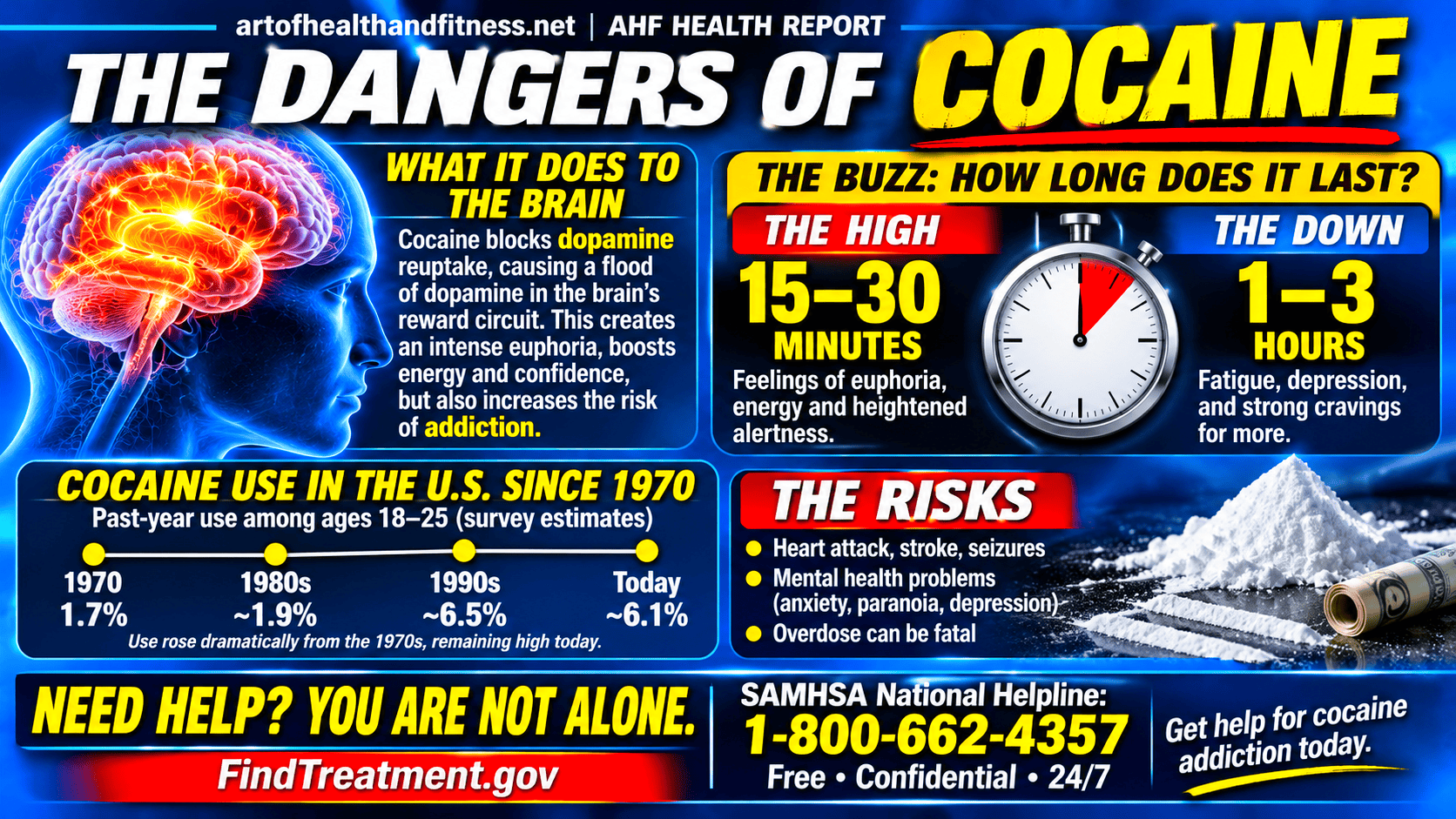
What makes cocaine different from many other substances is how short the effect is. The faster the drug reaches the brain, the more intense the high and the shorter it lasts. Snorted cocaine has a slower onset, and the effects may last roughly 15 to 30 minutes, while smoked crack produces an almost immediate rush that fades in about five to ten minutes. That rapid rise and fall is the trap. As the euphoria collapses, it is replaced by irritability, anxiety, a flat mood, and a powerful urge to use again, so people tend to chase the first feeling with repeated use over hours or days. The comedown, commonly called the crash, brings exhaustion, depression, heavy sleep, and intense cravings. With heavier use it can also include paranoia, restlessness, and in some cases hallucinations, including the sensation of bugs crawling under the skin that users sometimes call coke bugs.
How Cocaine Affects the Brain: Dopamine, Reuptake, and the Reward Circuit
Cocaine works by interfering with the way nerve cells recycle chemical messengers. Normally, a brain cell releases dopamine into the tiny gap between neurons, and a transporter pulls it back in to shut the signal off. Cocaine blocks that transporter, so dopamine piles up in the gap and keeps stimulating the next cell. It also blocks the reuptake of serotonin and norepinephrine, which adds to the energy and alertness. This is an important distinction from amphetamine and methamphetamine, which force cells to dump out extra dopamine in addition to blocking the cleanup. Cocaine simply stops the cleanup, and that is one reason methamphetamine tends to hit harder and last far longer.
So how much dopamine are we talking about? Exact numbers are hard to give for humans, because most of the direct measurements come from animal studies. In one classic experiment in rats, dopamine in the brain’s reward center rose about 37 percent when the animals pressed a lever to get food, but climbed roughly five times above baseline after cocaine or amphetamine was given. The numbers vary by species, dose, and measurement method, but the takeaway is consistent across the research: the surge dwarfs anything that food, social connection, or exercise delivers, and when the drug is smoked or injected it arrives within seconds. The National Institute on Drug Abuse explains that this surge, arriving at the same moment as the euphoria, teaches the brain that the drug is something worth seeking out again. Scientists describe two pieces of this process, reward, which is the high itself, and reinforcement, which is the powerful desire to take the drug again.
Repeated use changes the brain in ways that make quitting harder. The reward circuit adapts to the constant excess of dopamine by becoming less sensitive to it, which is why people need stronger or more frequent use to feel the same effect and why ordinary pleasures such as food, music, or time with family start to feel dull. That loss of the ability to feel pleasure is called anhedonia, and it is a major driver of relapse. Cocaine also affects the brain’s stress circuits and the glutamate system involved in learning and memory, which helps explain why places, people, and moods connected to past use can trigger intense cravings long after someone has stopped.
What Cocaine and Crack Do to Your Body
The cardiovascular system takes the biggest hit. Cocaine speeds the heart, raises blood pressure, and narrows blood vessels all at once, a combination that can trigger heart attacks, dangerous heart rhythms, and strokes, including in young people with no known heart problems. Seizures and dangerously high body temperature can occur as well. Mixing cocaine with alcohol creates an additional toxic compound in the body that puts even more strain on the heart, and combining it with opioids, a mix known as a speedball, has a long and tragic history of fatal overdoses.
The route of use shapes the damage. Regular snorting injures the lining of the nose and can eat away at the tissue that separates the nostrils. Smoking crack can inflame the lungs and cause what is commonly called crack lung, which involves fever, coughing up blood, and severe difficulty breathing. Injecting raises the risk of serious infections, including HIV and hepatitis C. On the mental health side, cocaine and crack can cause severe anxiety, paranoia, panic, aggression, and psychosis, and the crash that follows heavy use can bring deep depression. The signs of a cocaine overdose include trouble breathing, very high blood pressure, high body temperature, hallucinations, and extreme agitation, and there is no specific medication that reverses a cocaine overdose. Emergency care focuses on supporting breathing, controlling temperature, and managing the heart, which is why anyone showing these symptoms needs to get to an emergency room immediately.
Where Cocaine and Crack Use Is Highest in the United States
Cocaine use is not spread evenly across the map. Federal survey data has consistently shown the highest rates in the Northeast and parts of the West, and the lowest rates in much of the South and Midwest. In the most recent state-level rankings compiled from federal survey data, the states with the highest share of people reporting past-year cocaine use were Colorado, Vermont, the District of Columbia, Rhode Island, and Massachusetts, with New Hampshire and Wyoming among the lowest. A federal analysis of young adults aged 18 to 25 found the same regional pattern, with use ranging from about 4.2 percent in the Midwest to about 6.1 percent in the Northeast. Among the ten states with the highest young adult rates, six were in the Northeast, three were in the West, and one was in the South, while the lowest rates were mostly in the South and Midwest, with Mississippi at the bottom and New Hampshire at the top.
Crack has a different profile from powder. In the 2022 National Survey on Drug Use and Health, about 918,000 people aged 12 and older reported using crack in the past year, which is roughly 0.3 percent of the population, and Black Americans reported past-year crack use at about 0.9 percent compared with about 0.3 percent for White Americans and 0.1 percent for Hispanic Americans. Powder cocaine use, by contrast, did not differ significantly across racial and ethnic groups. It is worth remembering that household surveys tend to undercount the people who are hit hardest, including those who are homeless or incarcerated, so these numbers are best read as a floor rather than a ceiling.
Which Cities Have the Most Cocaine and Crack Use?
State rankings only tell part of the story, because cocaine has always been an urban drug first. Federal surveys going back to 2000 found that people in metropolitan areas were more likely to have used cocaine in the past year than people in non-metropolitan areas, and a wastewater study of 96 Oregon communities found that traces of cocaine were concentrated in larger urban areas and barely present in rural ones, while methamphetamine turned up in both. The pattern makes sense. Cocaine travels through major ports, highways, and airports, and it tends to stay close to the cities where it is distributed. A federal threat assessment from 2005 named Atlanta, Chicago, Los Angeles, Houston, Miami, and New York as the country’s priority cocaine markets, because they combined very high levels of local use with their role as regional or national distribution centers, and it described consumption as very high in Baltimore, Detroit, and Philadelphia as well. That assessment is older, but it offers a useful picture of how the drug moves through the country. The District of Columbia, which is a city rather than a state, has appeared near the top of federal rankings of past-year cocaine use for years, and international wastewater testing has found cocaine levels in American cities that are similar to those in the heaviest-using cities in Europe.
Crack has its own city story. The first crack house was discovered in Miami in 1982, the drug reached New York in 1983, and over the next few years it spread through urban neighborhoods in cities across the country. In New York City, a 1988 Bureau of Justice Statistics study tied crack to about 32 percent of all homicides and 60 percent of all drug-related homicides, and that violence, much of it connected to the illegal market around the drug, shaped how Americans thought about crack for a generation. Because crack was sold in tiny, cheap quantities, it spread fastest in neighborhoods where money was tight and street-level drug markets were already established, which leads directly to the question of who actually uses each form of the drug.
Income, Class, and Who Uses Powder Versus Crack
Powder cocaine and crack contain the same active ingredient, but the people who use them tend to look different. Crack became widespread in the 1980s especially among people of lower socioeconomic status, in part because it was sold in small rocks for as little as five or ten dollars, while powder cocaine usually cost fifty or a hundred dollars for a similar purchase. Powder cocaine, meanwhile, was long linked with parties, nightlife, alcohol, and a glamorous image, an image that the crack epidemic tarnished but never fully erased.
Research backs up that class divide. A 2015 study from New York University, published in the journal Drug and Alcohol Dependence and based on national survey data, found that higher education and higher family income were negatively associated with crack use, although those same factors were sometimes risk factors for powder cocaine use. Crack users were also more likely to report a lifetime arrest or multiple recent arrests. The researchers concluded that being poor was the strongest correlate of crack use, not race. Black Americans were at higher risk of crack use in the raw numbers, but that difference disappeared once the researchers accounted for other socioeconomic factors, although Black Americans who did use either form tended to use more frequently. Other research has found that persistent cocaine use has dropped sharply among people with a high school or college degree over the past few decades, leaving heavier use more concentrated among people with less education.
None of this means powder cocaine is a poor person’s problem or that crack is the only dangerous form. Powder cocaine is used across the income spectrum, including by people with steady jobs and money to spend, and those users are less likely to be arrested or to end up in the public health system. People who use both forms, or who use crack, are also more likely to be marginalized from their communities, which makes it harder to hold a job, find stable housing, and get into treatment. Money does not protect anyone from addiction or from a fatal overdose, but it does shape who gets caught, who gets treated, and who gets punished.
How Common Is Cocaine Use, and How Many People Die From It?
According to the 2022 National Survey on Drug Use and Health, about 5.3 million Americans aged 12 and older, or roughly 1.9 percent of the population, used cocaine in the past year, a figure that includes crack. That makes cocaine one of the most commonly used illegal drugs in the country, behind only marijuana. SAMHSA’s most recent survey results describe past-year cocaine use as largely stable across the 2021 to 2025 window, which means the number of people using has not collapsed, but it has not exploded either.
The death toll tells a harsher story. Overdose deaths involving cocaine rose from about 3,800 in 1999 to roughly 24,500 in 2021, and provisional federal data put the 2023 total at about 30,800. Rates among men have run about twice as high as among women. The most recent provisional data from the CDC shows a meaningful break in that trend, with cocaine-involved overdose deaths falling about 28 percent to roughly 22,200 in 2024 as overall overdose deaths dropped by about 27 percent. Experts credit a mix of factors, including wider access to naloxone, better access to treatment, and changes in the illegal drug supply, and they caution that the progress is fragile. A growing share of cocaine deaths in recent years has involved fentanyl, which can contaminate the supply, so people who think they are using cocaine alone may be exposed to a far more lethal opioid without knowing it.
A Short History of Cocaine in America
Coca leaves were chewed in the Andes for thousands of years, but cocaine as a modern drug begins in 1860, when chemist Albert Niemann isolated the pure compound from the leaf. In 1884, Sigmund Freud published a glowing paper on the drug he called a magical substance, and ophthalmologist Karl Koller showed it could be used as the first effective local anesthetic. Drug companies quickly marketed cocaine in tonics, toothache drops, and nerve remedies, and in 1886 pharmacist John Pemberton created the original Coca-Cola, which contained coca extract until the company removed it in 1903. By 1902 there were an estimated 200,000 cocaine addicts in the United States, and Freud himself struggled with the drug for years.
The Harrison Narcotics Act of 1914 pulled cocaine out of open sale, and use declined sharply through the 1940s, 1950s, and 1960s. It came roaring back in the 1970s, when it was glamorized in music, film, and nightlife and widely believed to be non-addictive, a belief that proved disastrously wrong. The Controlled Substances Act of 1970 made it a Schedule II drug. By 1982, one widely cited estimate put the number of American cocaine users at about 10.4 million, which is often described as the all-time peak. Then came crack. The first crack house was discovered in Miami in 1982, the drug had reached New York by 1983, and by the mid-1980s it was spreading through cities across the country, sold for as little as five dollars a rock. Between 1985 and 1989 the number of regular cocaine users jumped from about 4.2 million to about 5.8 million. The Anti-Drug Abuse Act of 1986 set federal sentencing rules that treated one gram of crack like 100 grams of powder, a disparity that fell overwhelmingly on Black defendants and was only partly corrected by the Fair Sentencing Act of 2010, which narrowed the ratio to 18 to 1.
How Prison Sentences for Crack and Powder Cocaine Differ
Because crack and powder cocaine are chemically the same drug, the way the law treats them is one of the most debated issues in American criminal justice. The Anti-Drug Abuse Act of 1986 tied federal mandatory minimum sentences to the weight of the drug, and it set the thresholds 100 times lower for crack. Five grams of crack triggered a mandatory five-year federal sentence, the same as 500 grams of powder, and 50 grams of crack triggered a ten-year minimum, the same as five kilograms of powder. The law also created a five-year mandatory minimum for simple possession of crack, with no equivalent for powder. Congress passed it in the wave of alarm that followed the 1986 death of basketball star Len Bias, and the story took hold that crack was uniquely deadly even after it became known that the drug involved in his death was powder cocaine.
The Fair Sentencing Act of 2010 reduced the gap but did not close it. It raised the crack thresholds to 28 grams for the five-year minimum and 280 grams for the ten-year minimum, which works out to a ratio of roughly 18 to 1, and it eliminated the mandatory minimum for simple crack possession. Today, 28 grams of crack still carries the same mandatory minimum as 500 grams of powder. The First Step Act of 2018 made those changes retroactive, which led to sentence reductions for more than 3,000 people, with an average cut of about six years. In 2021, however, the Supreme Court ruled in Terry v. United States that the retroactive relief applies only to people whose crack offense triggered a mandatory minimum in the first place, which left many others out.
The racial impact of the disparity is the main reason it has drawn such sharp criticism. According to the U.S. Sentencing Commission, Black defendants made up nearly 77 percent of federal crack cocaine convictions in fiscal year 2020, and the Justice Department noted that as of March 2021, about 87.5 percent of people serving federal prison time for trafficking offenses primarily involving crack were Black. That is despite the fact that white and Latino Americans have historically made up more than two thirds of crack users. In 2009, the last full year of the 100 to 1 ratio, about 79 percent of people arrested for crack were Black, compared with about 28 percent of people arrested for powder cocaine. Researchers have also found that cutting the sentencing gap in 2010 was not associated with an increase in crack use, which undercuts the argument that harsher penalties are what keep use down. Supporters of keeping some disparity argue that crack is more addictive and more closely tied to violence, while opponents point to the lack of any chemical difference between the two forms.
The effort to eliminate the gap entirely has stalled. The bipartisan EQUAL Act would treat crack and powder cocaine the same under federal law and allow people currently serving crack sentences to seek resentencing. It passed the House by a vote of 361 to 66 in 2021, but it never cleared the Senate, and a version reintroduced in 2023 expired with that Congress in January 2025. As far as I could find, the 18 to 1 ratio is still federal law. A 2022 Justice Department memo directed federal prosecutors to charge crack and powder cases as if the two were the same, but that was policy guidance, not law, and it can change with each administration. Some states have acted on their own, with Missouri eliminating its crack and powder gap in 2023, and because most drug cases are prosecuted in state courts, sentences for the same amount of cocaine can still vary widely depending on where a person is arrested.
Has Cocaine Use Declined Over the Years?
Compared with the early 1980s peak, yes, use is far lower. The number of Americans using cocaine fell dramatically through the late 1980s and 1990s as public awareness grew, enforcement increased, and the crack epidemic burned itself out in many cities. In recent years, though, the picture has been more of a plateau than a steady decline. Federal data showed a notable increase in new cocaine users in 2015, with about 968,000 people trying it for the first time that year, up 26 percent from the year before, and past-year use has hovered in a fairly narrow band since. The surveys changed their methods over the decades, so direct comparisons across eras are best treated as directional rather than exact.
The more important lesson is that fewer users does not automatically mean less harm. Cocaine-involved overdose deaths climbed for more than two decades even as overall use stayed well below its 1980s peak, driven in part by a more dangerous drug supply and by aging users with accumulated heart damage. The recent drop in deaths is encouraging, but it came from a historically high starting point.
Treatment Options for Cocaine and Crack Addiction
Here is the part that surprises many people: unlike opioid addiction, which can be treated with medications such as methadone and buprenorphine, there is currently no FDA-approved medication specifically for cocaine use disorder. The National Institute on Drug Abuse supports an active medication development pipeline, but for now the best-supported treatments are behavioral. That does not mean treatment fails. It means the work is done through therapy, structure, and support, and it usually takes longer and demands more from the person than a single prescription would.
Contingency management has the strongest evidence base of any approach for stimulant addiction. It works by giving people tangible rewards, such as vouchers or small prizes, for verified drug-free test results, which reinforces recovery in a direct and measurable way and helps retrain a reward system that cocaine has dulled. Cognitive behavioral therapy is commonly used alongside it to help people spot the triggers, people, places, and emotions that lead to use and to build practical coping skills. Motivational interviewing, dialectical behavior therapy, group counseling, and therapeutic communities, which are drug-free residential programs, are all part of the toolbox, and many people also lean on peer groups such as Cocaine Anonymous. Doctors may prescribe medication to treat the depression, anxiety, or insomnia that often accompany early recovery, even though those drugs do not treat the addiction itself, and researchers are testing other medications in clinical trials under careful supervision. That is not something to try on your own.
Withdrawal from cocaine is usually not medically dangerous in the way alcohol withdrawal can be, but the crash can bring crushing fatigue, deep depression, and intense cravings, and the risk of suicidal thoughts is real. Researchers have described success rates for cocaine treatment as below 50 percent, which is why long-term support, relapse planning, and treating co-occurring mental health conditions matter so much. Relapse is common and does not mean treatment has failed. It means the plan needs adjusting.
The Bottom Line
Cocaine and crack are two forms of the same powerful stimulant, and both can hijack the brain’s reward system quickly, strain the heart in ways that kill, and leave people stuck in a cycle of short highs and hard crashes. Use is concentrated in the Northeast and parts of the West, crack in particular carries a heavy legacy in American history, and deaths remain high even after the recent decline. The encouraging truth is that people do recover, and the approaches with the best evidence, especially contingency management combined with counseling, are available today. If you or someone you love is struggling, the Substance Abuse and Mental Health Services Administration runs a free, confidential National Helpline at 1-800-662-4357, open 24 hours a day, every day of the year, and anyone in crisis can call or text 988 at any time.
Sources: SAMHSA National Survey on Drug Use and Health, CDC National Center for Health Statistics, National Institute on Drug Abuse, NYU Center for Drug Use and HIV Research, U.S. Sentencing Commission data as reported by the U.S. Department of Justice, the Congressional Research Service, PBS Frontline, and HISTORY.com research summaries.
Comments

No Comments Yet